
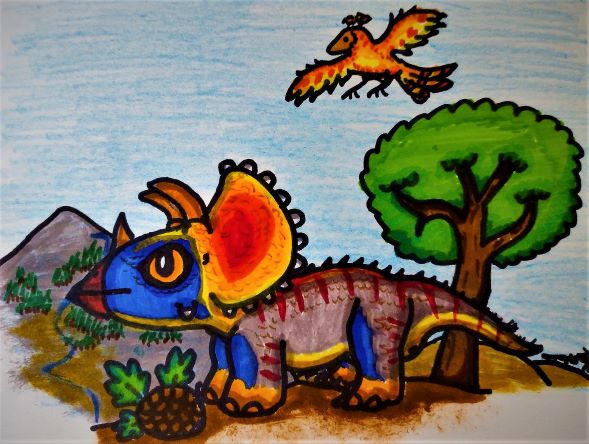
The Triceratops is the second most iconic dinosaur after T-rex. Triceratops was a ceratopsid, a group of dinosaurs all identified by neck frills and at least a few small horns. However, Triceratops’ horns were not small by any means. In the drawing above, you can see that it had a horn on its nose, two above its eyes, and many nubs on the frill.
Triceratops featured in the Jurassic Park movie franchise, where it was shown to be suffering from eating stones that had crushed poisonous berries. It was shown to be a dull dun color. In real life, the Triceratops was probably a bit brighter colored among the males and the females would have had patterns to hide in the dry forests that were their natural homes. Unlike popular belief, Triceratops did not appear to have traveled in herds, while its relative Centrosaurus appeared to have lived in massive herds.
Triceratops was herbivorous, and consumed a lot of plant matter in a sitting. However, unlike its portrayal in Jurassic Park, it did not eat stones to help with breaking down food; the purpose of the so-called ‘gizzard stones’ found in many herbivorous dinosaurs is unknown. One fact that has been revealed about Triceratops is that specimens previously thought to be from other dinosaurs were probably juveniles of the Triceratops.
Triceratops lived in the Late Cretaceous around 68 mya, and was one of the last known ceratopsids. Many of its cousins were Chasmosaurus, Torosaurus (probably an aged adult form), Styracosaurus, and Centrosaurus. It died out 66 mya at the end of the Cretaceous, along with its predator T-rex.

 Anay Ganesh