
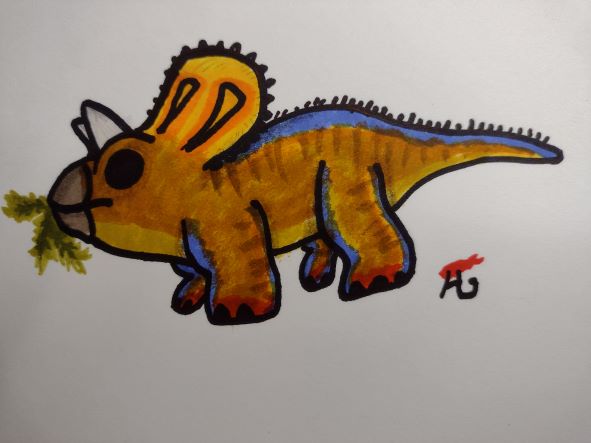
If we go back in time, one may recall Nothronychus, the therizinosaur that I wrote about for my N dino. In that post, I mentioned Zuniceratops as living in the same era and place as Nothronychus; namely, New Mexico in the Late Cretaceous.
Zuniceratops means ‘Zuni horned face’ because the region that it was found was once the land of the Zuni people. Zuniceratops was not a chasmosaurine or centrosaurine, but instead was the ancestor of both lineages. Zuniceratops looked a lot like a juvenile Triceratops, however, with two brow-horns. However, there is a lack of nose-horns and the frill is diamond-shaped and not circular. There are no knobs surrounding the frill and the animal was the size of a sheep.
Zuniceratops lived in the Late Cretaceous, but it predated other more advanced ceratopsians by 10 million years and was not part of the older ceratopsians such as Protoceratops and Psittacosaurus. It exhibits some features, such as small size and lack of a nose horn, but large frills and brow-horns are staples of chasmosaurs and early centrosaurs. Therefore, most paleontologists agree that Zuniceratops is a sort of ‘missing link’ between the early ceratopsians (which were closely related to Micropachycephalosaurus) and the advanced ceratopsians such as Triceratops, Xenoceratops, etc.

 Anay Ganesh