
In popular culture, dinosaurs are usually bland reptilian monsters that are basically larger-than-life crocodiles. While this representation with brown and green scales and thin, sinewy bodies does serve its purpose of frightening the audience (i.e. Jurassic Park), its not scientifically accurate from what we know.
Browns and greens are common colors for reptiles, but they’re usually restricted to females in birds, who are more closely related to dinosaurs. Since birds have a brain comparable to dinosaurs’, we can assume that behaviors were similar. Therefore, dinosaur males probably sang and danced and did all sorts of weird stuff to get the girls’ attention. This also meant that just like in birds, many dinosaurs were brightly colored and had patterns and stripes. But, since we only have bones, how can we be sure?
The answer is that we actually have feather impressions, skin impressions, even a whole mummy. Now, maniraptoran wings are almost identical to birds except in that they aren’t strong enough to fly. The feathers are identical, so the same kind of pigmentation shows up in the form of melanosomes, organelles in vertebrate cells that make a pigment called melanin. Melanin determines many colors in bird feathers, fur, and our skin, hair, and eyes. The shape of the melanosome determines the color of the cell.
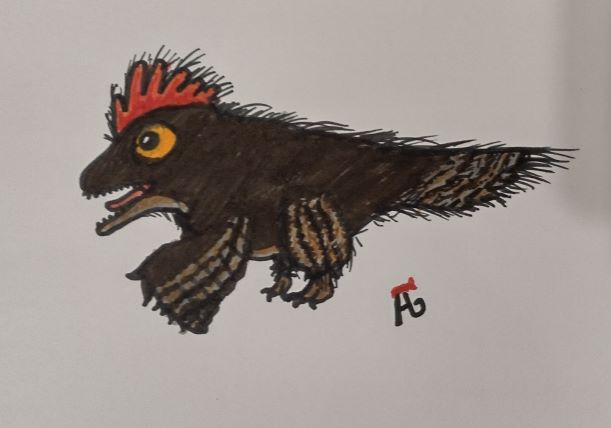
Enter Anchiornis huxleyi, a theropod from the Late Jurassic of China. It was the size of a crow, and the first dinosaur whose colors have been fully described. The imprints of melanosomes still remain on the wing imprints of the specimen, and we can deduce that Anchiornis had glossy black feathers with white stripes on the wings and tail. It also had a red crest and looked very much like a pileated woodpecker.
Anchiornis was a paravian, a group of maniraptorans that included troodontids, dromaeosaurs, birds, scansoriopterygids, and anchiornithids. Paravian means ‘like unto birds’ and includes the most bird-like dinosaurs. Anchiornis is in its own family, Anchiornithidae, but there is still debate over whether they are more closely related to birds or troodontids.

 Anay Ganesh