
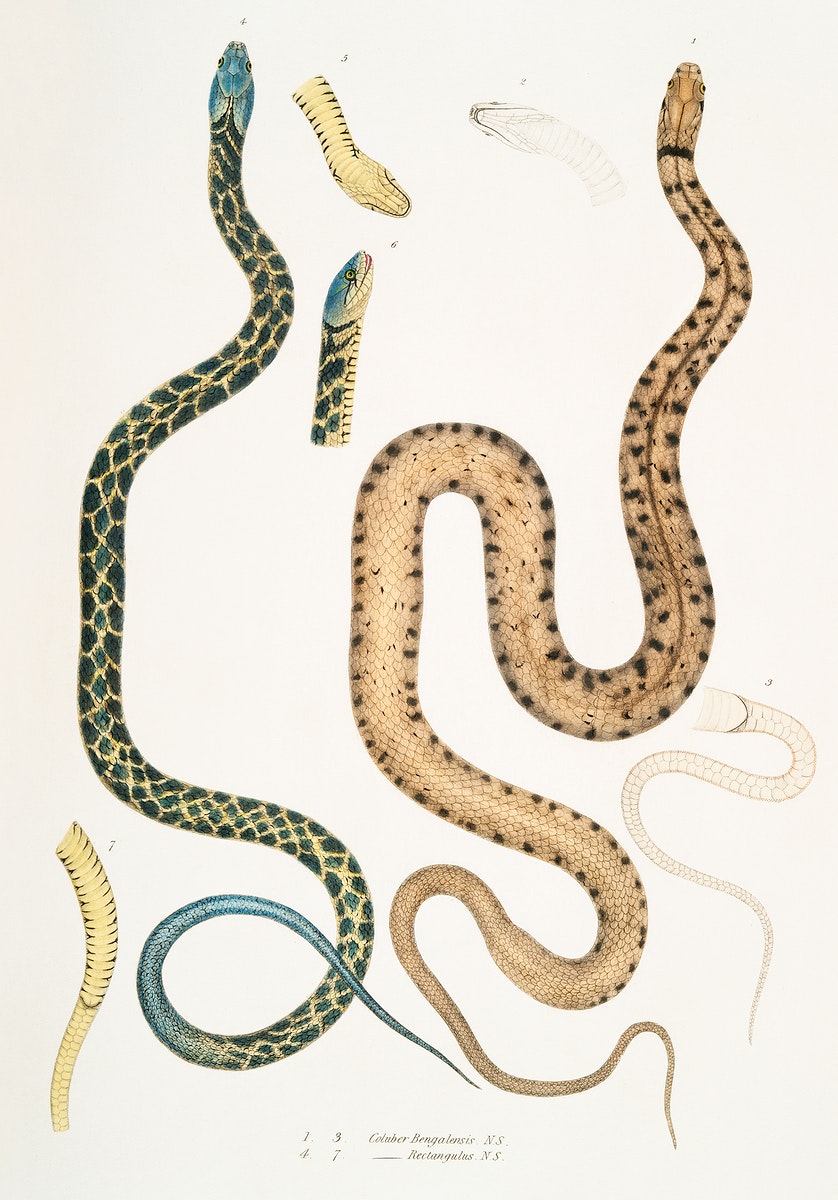
Snakes. Some find them cool, others creepy. Some snakes are venomous, some will squish you to death. Snakes are pretty much scaly lizards without legs that make hissing noises, right? Well, not completely. Here’s what most people actually don’t know about snakes and what makes them different from actual “legless lizards”.
First of all, snakes are closely related to and did evolve from lizards. But, not all snakes are in fact limbless. The Burmese Python, for example, has tiny vestiges of limbs hidden in its skeleton. Snakes diverged (split off) from lizards in the Cretaceous period, around 70 million years ago. Since then, they’ve rapidly spread to a ton of species and just about every level of danger.
One major difference among snakes and lizards is that snakes have enhanced canines, or fangs. The term “fangs” is usually used when only talking about venomous snakes here, though. Another major difference is that the jaws are much more loosely held in snakes because snakes don’t chew and they swallow large prey. Snakes’ jaws are not fully fused (they have two jawbones on each side); their jawbones are connected by a strip of cartilage so the jaws can extend really, really wide.
Snakes are divided into many major families, mainly the Elapidae, the Colubridae, the Viperidae, Pythonidae, and Boidae. The Elapidae are the most dangerous snakes and contain most of the venomous ones. Cobras, taipans, sea snakes, and the ironically harmless gartersnake are all Elapids.
Colubrids are the largest family but include more milder and usually non-venomous snakes. The highly venomous vine snakes, boomslangs, and keelback snakes (all three have caused human fatalities) and the harmless kingsnakes or milksnakes are also included in Colubridae.
Viperidae are obviously vipers. Vipers, along with rattlesnakes, adders, copperheads, and coppermouths are all included in Viperidae. Pit vipers (rattlesnakes and lanceheads) have some of the most painful and potent venoms apart from the Elapids. The venom of the golden lancehead, one of the most venomous snakes in the world, can literally burn through human flesh.
Pythonidae again is an obvious one. Pythons are the longest snakes in the world, an invasive species, and for some reason people’s favorite exotic pet. Pythons are serious predators, though. Pythons are constrictors, which means that they squish and wrap around their prey to kill it. Pythons are all non-venomous, but possess lots of camouflage, blending in with the shadows of the forest. Burmese Pythons are a serious invasive species in the Florida Everglades after illegal pet owners abandoned them in the wild.
Boidae consists of the boas and the anacondas, the heaviest snakes and the most powerful constrictors. Green anacondas are very heavy and have been prominently featured in the Anaconda movie series, which is about super-sized anacondas killing people. While those anacondas are overly gigantic and are put in the wrong country, real anacondas are still dangerous.
So, that’s our overview on snakes!

 Anay Ganesh